
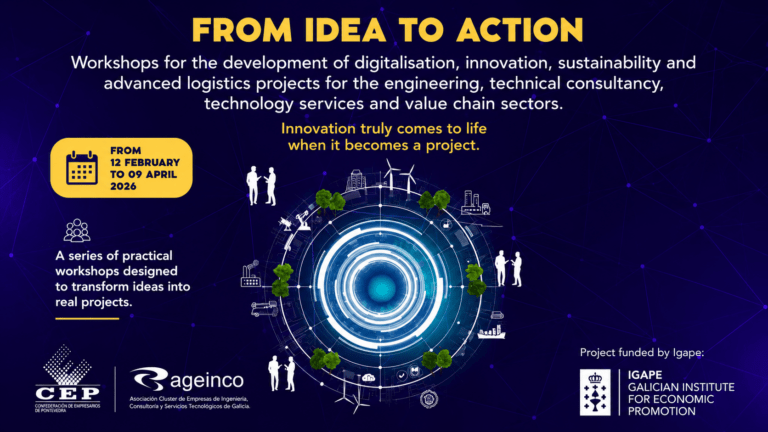
The Confederation of Employers of Pontevedra (CEP), in collaboration with AGEINCO, held the third workshop of the “From Idea to Action” programme, focused on analysing real-world blockchain applications in the fields of engineering, technical consultancy, and technology services.
The session approached blockchain from a practical perspective, conveying a key message: blockchain should not be viewed as a standalone solution, but rather as a digital trust infrastructure capable of transforming business processes into systems based on verifiable evidence.
A Structural Challenge for the Sector: Managing Trust
During the workshop, participants examined the complexity of technical projects, which often involve multiple stakeholders—including companies, subcontractors, public administrations, and clients—and where recurring challenges frequently arise:
- Multiple versions of documents
- Difficulties in proving the creation and delivery of project outputs
- Complex audit processes
- Contractual disputes and delays in approvals
In this context, it was highlighted that many processes still rely primarily on administrative trust and document management rather than on systems capable of generating verifiable evidence.
Blockchain as a Verification Layer for Existing Systems
One of the central messages of the workshop was that blockchain does not replace existing systems such as ERP platforms, BIM environments, or document management tools. Instead, it acts as an additional layer that enables events to be recorded and verified in an immutable and shared manner.
The process was explained in simple terms:
- An event is generated (a document, milestone, or data record).
- A cryptographic proof is created.
- The proof is registered on the blockchain.
- It can then be independently verified by different stakeholders.
This approach provides:
- Information immutability
- Complete traceability
- Shared trust between organisations
Real Use Cases for the Sector
The workshop was structured around practical applications directly related to the activities of participating companies.
Document Certification and Technical Evidence
The registration of cryptographic proofs for:
- Technical reports
- Drawings and plans
- Certifications
- Audits
This allows organisations to guarantee document integrity and streamline audit processes.
Digital Product Passports and Sustainability
The session explored the impact of the Digital Product Passport, linked to emerging European sustainability regulations, which will enable organisations to:
- Trace the origin of materials
- Measure carbon footprints
- Ensure transparency throughout the value chain
This is particularly relevant for sectors such as construction, industry, and energy.
Logistics and Supply Chain Management
Blockchain can be used to:
- Record logistics events in a shared environment
- Verify certifications
- Improve material traceability
This reduces fraud risks and increases transparency between organisations.
Evidence-Based Project Management
Participants explored integration with systems such as BIM, enabling organisations to:
- Record project milestones in a verifiable manner
- Automate processes through smart contracts
- Reduce contractual disputes
This approach represents a shift in mindset—from traditional document management to evidence-based digital project management.
Asset Tokenisation in Engineering Projects
The workshop also examined new financing opportunities through asset tokenisation, enabling organisations to:
- Digitally represent infrastructure assets or projects
- Facilitate participation by multiple investors
- Automate revenue distribution
Its potential was highlighted in sectors such as energy, infrastructure, and industrial assets.
A Technology with Real Business Impact
Throughout the session, it became clear that blockchain is evolving from a purely technological concept into a key business infrastructure for B2B environments, where trust, traceability, and coordination among multiple stakeholders are essential.
Due to its complexity and highly regulated nature, the engineering sector is emerging as one of the areas with the greatest potential for blockchain adoption.
Programme Continuity
This third workshop forms part of the programme promoted by CEP and AGEINCO, designed to support companies in identifying technological opportunities and developing real projects aligned with available funding mechanisms.
The next workshop will take the process one step further by focusing on the definition and structuring of concrete digitalisation, innovation, and sustainability projects, reinforcing the programme’s core objective: turning ideas into action.




 C/ García Barbón 104, Oficina 6
 T. +34 617 784 986