
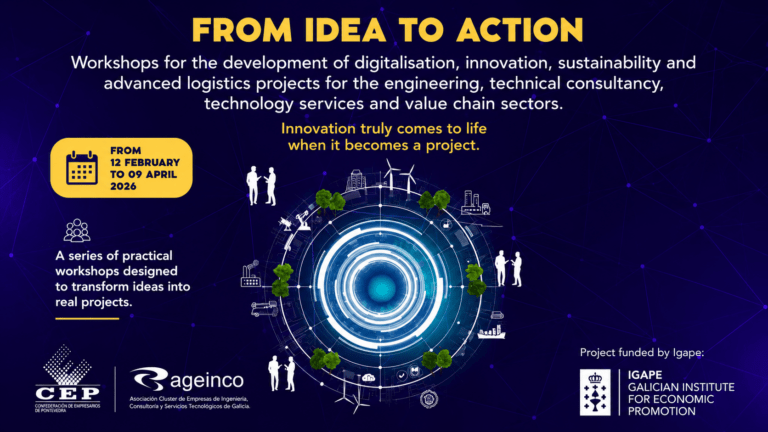
The Confederation of Employers of Pontevedra (CEP), in collaboration with AGEINCO, held the second workshop of its programme focused on the practical application of Artificial Intelligence in engineering firms, technical consultancy companies, and technology service providers.
The session, delivered by Gonzalo Pellejero, approached AI from a clear perspective: shifting the focus from the technology itself to the business challenge, demonstrating how real-world solutions can be applied to specific operational contexts.
Artificial Intelligence Applied to Engineering: From Data to Decision-Making
CEP and AGEINCO hosted the second workshop of the programme together with the Confederation of Employers of Pontevedra, focusing on one of the key drivers of transformation in the sector: the application of Artificial Intelligence to real business challenges.
The session, led by Gonzalo Pellejero, was based on a straightforward principle: AI should not be implemented simply because it is a trend, but because it can effectively solve specific business problems using the right technology.
From Theory to Practice: AI with Real Impact
Far from being a purely conceptual discussion, the workshop was entirely structured around real-world implementations, allowing participating companies to identify practical applications directly relevant to their own operations.
Among the topics covered were:
Process Mining Applied to Operations
A real case study involving more than 1.6 million records was analysed, demonstrating how organisations can:
- Detect process bottlenecks
- Identify deviations between designed and actual workflows
- Analyse operational efficiency and process timing
- Visualise interaction networks between teams
This case highlighted a key message: information systems already contain a company’s strategic knowledge, but that knowledge is not always fully leveraged.
Intelligent Automation Through Bots
Practical solutions were presented, including:
- Large-scale data extraction from external sources
- AI-powered automatic classification
- Assisted generation of technical documentation
- Creation of databases that can be leveraged by language models
Particular emphasis was placed on legal compliance and accountability within automated processes, a critical aspect for the engineering sector.
Advanced Analytics and Predictive Models
The workshop also explored use cases based on graph analysis and simulation, including:
- Traffic and urban flow modelling
- Route planning and optimisation
- Identification of critical infrastructure points
Computer Vision and Automated Detection
Real-world applications included:
- Crowd monitoring and occupancy control at events
- Detection of incidents in public spaces
- Automated image analysis in industrial environments
A Clear Message for the Sector
The workshop concluded with a key takeaway:
Artificial Intelligence is not a standalone technology; it is an intelligence layer built on top of existing business processes.
Participating companies identified genuine opportunities for implementation, but also recognised a clear need: guidance in defining use cases and supporting the practical deployment of AI solutions within their organisations.




 C/ García Barbón 104, Oficina 6
 T. +34 617 784 986